On 25 May Africa celebrates. And it has good reason to do so.
While today is officially Africa Day, a day noting the formation in 1963 of the Organisation African Unity, now the African Union, it is worthwhile using this day to reflect on our perceptions of the continent.
Africa has, through recent history, been targeted for its natural riches by wealthy nations and corporations, left reeling from conflicts, historical injustices, slavery and colonialism – and often abandoned to its own fate, think of the Covid-19 vaccines debates taking place right now.
And yet, Africa is stronger and much more complex than its recent history or current news stories would have you believe.
It is a continent rich in culture and an entrepreneurial can do attitude alongside a deep spirituality; a level of creativity that comes from its very bones; and a generosity of nature seldom seen elsewhere in the widespread practice of Ubuntu.
Of a global population of 7.8 billion, some 1.2 billion call Africa home right now. Yet the seeds of each and every one of us were planted right here, millions of years ago. Archaeologists may differ on where on the continent those seeds took root, but on one thing they are all agreed – our origins lie deep in the Africa soil.
And for that reason alone, Africa Day should be a global celebration.
Transformation
It is here that our ancestors physically and mentally transformed, their development seen in the fossil records left across the continent, in the stone tools they used, in the art they produced on the rocks, and even in their genetic materials.
This complex, interwoven journey from the earliest times of the australopiths between 3.5 and 3.2 million years ago through to the emergence of modern humans around 300 000 years ago was never a simple linear one. It involved a messy intermingling of groups and even species as they migrated across vast regions.
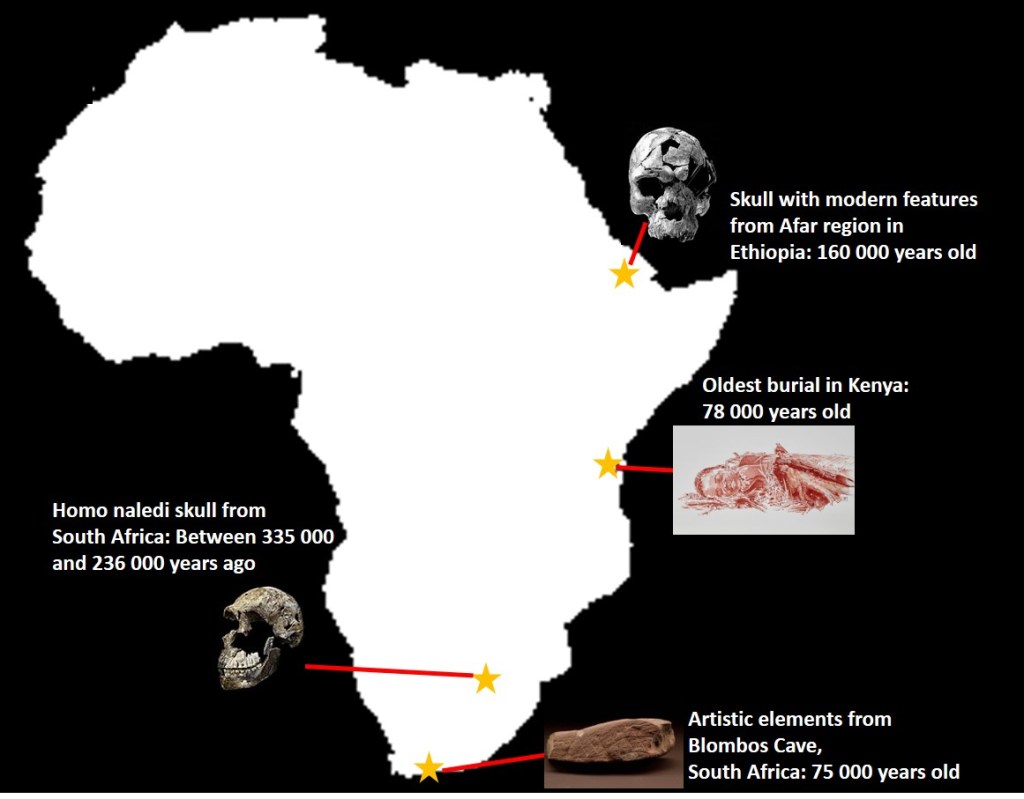
During this vast expanse of time, hominins learnt to walk upright, use stone tools, tame fire and live in social groups. And it is here, in Africa, that the final iteration of hominins, Homo sapiens, refined their ability for abstract thought, for planning, for using symbols, for cultural connections – and even for storytelling.
By 160 000 years ago, evidence of modern humans is found far and wide across the continent.
And why is this important?
Humans evolved, archaeologists and geneticists suggest, through learning how to cooperate. Different groups shared their culture – their values, ideas and beliefs – and knowledge, benefitting from pooling their experiences . As they mixed, they accessed multiple solutions to challenges, found ways to modify their behaviour, and, in so doing, developed complex intellectual skills.
However, today we find ourselves in a world where nations hold onto knowledge, seldom willing to share their expertise or their discoveries – again, think of the debate over sharing the intellectual property around the Covid-19 vaccines.
Africa gave us everything we needed. What are we giving back? Perhaps it’s time for all of us to reflect on our commonalities, on our heritage and history as human beings. After all, #JeSuisAfrique.
 Jenn Writes
Leave a comment