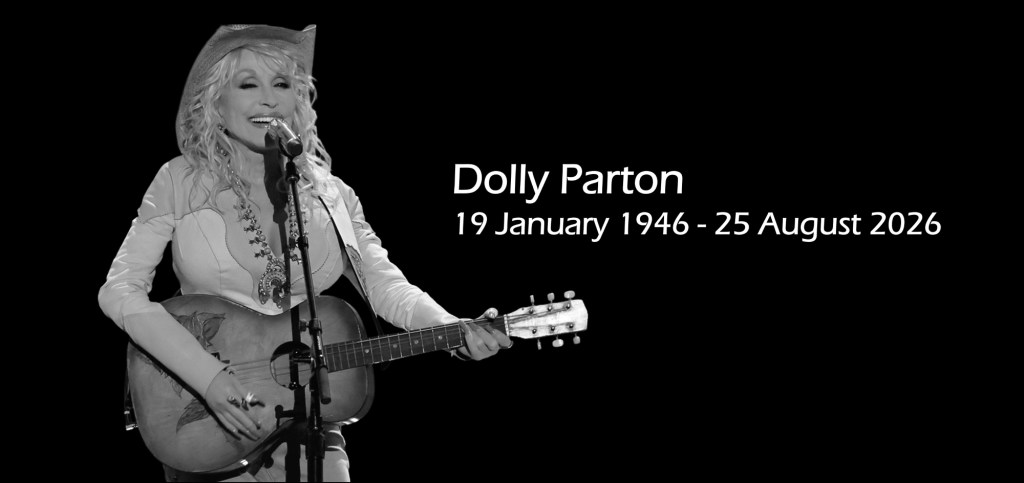
There are people whose deaths make us realise how much of our lives they had quietly occupied. Dolly Parton was one of those people.
The tributes will rightly celebrate the extraordinary voice, the songs, the films, the rhinestones, the towering blonde hair, the humour, the business empire and the philanthropy. But I don’t think that is why Dolly Parton belonged to so many people.
It wasn’t her singing. It wasn’t her looks. It wasn’t even the hit records.
It was the stories.
Dolly understood something that many immensely talented entertainers never quite grasp: people don’t necessarily remember you because you entertained them. They remember you because, somewhere along the way, you told a story that sounded like their own.
That was Dolly’s great gift. She could take the particular and make it universal.
She came from poverty in rural Tennessee. She knew what it was to have very little. She knew about families, ambition, disappointment, work, love, loneliness, sacrifice and hope. She could write about a woman whose heart was breaking, a family that had almost nothing, a working woman who was tired of being undervalued, a person desperately trying to hold on to someone they loved.
And somehow, those stories travelled. They crossed the Appalachian mountains. They crossed class and geography. They crossed generations. They crossed musical genres. And they travelled much further than America. They travelled all the way to Africa.
For someone growing up thousands of kilometres from Tennessee, Dolly’s world could seem impossibly distant: the mountains, the country roads, the accents, the clothes, the particularities of American rural life.
But the emotions were never distant.
You did not have to be from Tennessee to understand Dolly. You did not have to be American. You did not even have to be a country music fan.
You simply had to have loved someone. Or lost someone. Or wanted something you could not have. Or felt poor. Or felt invisible. Or worked too hard. Or wondered whether you were good enough. Or remembered the place you came from.
That is why her reach could extend from a small community in Tennessee to a township in South Africa, from Nashville to Nairobi, from the American South to homes across the African continent. The circumstances changed, but the human truths did not.
There is something particularly powerful about that when you think about Africa.
Africa has no shortage of stories about hardship, resilience, family, migration, ambition, poverty, love and survival. We know what it means to make something out of very little. We know the complicated relationship between where we come from and where we hope to go. We know the importance of family, of mothers and fathers, of leaving home, of remembering home.
Dolly’s stories could find those points of connection without pretending that our experiences were identical. That is the difference between cultural export and cultural connection.
She did not need to be African to speak to Africans. She simply had to be human.
And perhaps that is why Dolly became something more than an American country star. She became one of those rare global figures whose work could be received without requiring people to share her background.
Her songs were translated by circumstance, rather than language. The heartbreak was ours. The longing was ours. The hope was ours. The humour was ours.
The struggle to become something more without forgetting where we came from was ours.
That was the difference between a song that becomes a hit and a song that becomes part of people’s lives.
Dolly was an extraordinary songwriter because she understood that the biggest stories are often hidden inside the smallest.
A coat made from scraps of cloth could become a meditation on poverty, pride and the dignity of a child who does not yet understand that the world considers her poor.
A woman watching another woman take the person she loves can become an examination of jealousy, vulnerability and the terrifying possibility of being replaced.
A day at work can become a story about women discovering that their labour has value.
A goodbye can become an expression of love so painful that it belongs to anyone who has ever had to let someone go.
The genius was not simply in writing those stories. It was in refusing to make them complicated.
Dolly had an extraordinary ability to speak plainly about complicated things. That may be one of the reasons she became so difficult to dislike.
There was no intellectual barrier to entry. She did not require you to know anything before you could understand her. She could make you laugh and then, almost without warning, make you cry.
She could be outrageous without being cruel. Glamorous without seeming distant. Successful without pretending she had always belonged among the successful. And beneath the jokes and the enormous personality was something much more serious: empathy.
Dolly knew that every person carries a story that nobody else can completely see.
Perhaps that is why her generosity never seemed entirely separate from her art. The Imagination Library, which put books into the hands of children, grew from the same instinct that drove her songwriting: give people a story; give them a chance to imagine another life.
There was also something profoundly democratic about Dolly. She never seemed embarrassed by where she came from. She did not spend her life trying to erase the girl from the Tennessee mountains in order to become a global celebrity. She took that girl with her.
That matters, because so much of modern success is presented as a process of reinvention: become richer, more sophisticated, more educated, more fashionable, more important. Dolly offered another possibility.
You can rise without disowning your roots. You can become enormously successful without pretending you were never poor. You can become famous without believing you are better than other people. And you can build something extraordinary while remaining recognisably human.
Perhaps that is why people who otherwise have very little in common could claim Dolly as their own. She belonged to country music, but not only to country music. She belonged to America, but not only to America.
She belonged to anyone who recognised themselves in one of her stories – and that is a rare gift.
It is also why her death feels larger than the death of a musician.
We are not simply losing the woman who wrote “Jolene” or “I Will Always Love You”. We are losing one of the great storytellers of the modern age.
And storytellers matter because stories are how we recognise ourselves.
The remarkable thing about Dolly Parton’s stories was that they never insisted that you become somebody else before you were worthy of being heard. She told you that ordinary lives were worth singing about. That poor people had dignity. That working people had dreams. That women had ambitions. That heartbreak was not weakness. That laughter could sit easily with grief. That success did not require shame about where you started.
And perhaps most importantly, she understood that kindness was not a soft thing. It was a way of seeing.
This is why people who have never bought a Dolly Parton album or download will still feel something today.
They may not know all the songs. They may not have watched all the films. They may never have understood country music. But they know the feeling.
They know what it is to be Dolly’s person in one of her stories. The lonely person. The hopeful person. The person trying to make something out of very little. The person who has loved and lost. The person who wants to be seen. The person who wakes up one morning and decides to try again.
That was Dolly’s real genius. She didn’t merely sing to people; she recognised them. And when an artist can make millions of strangers feel recognised – in Tennessee, Johannesburg, Lagos, Nairobi or anywhere else – their work becomes much more than entertainment; it becomes a kind of shared memory.
Dolly Parton understood that the distance between one human being and another is often smaller than we imagine. Tell the right story, she seemed to say, and all barriers fall away, and, for a few minutes, we are simply humans listening to another human being tell us something we already knew, but had never quite found the words to say.
That is why Dolly mattered, and will remain ever-present: not simply in the songs, but in the stories – and, more importantly, in the hearts of the people who heard themselves in them.


Leave a Reply